category: “RPL Peptide”
How to Verify a Chinese Peptide Manufacturer: Remote Audit Checklist
TL;DR — The Short Answer
Verifying a Chinese peptide manufacturer involves six verification layers: business registration validation, manufacturing equipment and facility verification, COA authenticity assessment, batch documentation review, communication quality assessment, and a trial order evaluation. Each layer provides incremental confidence. For remote verification, video calls are the gold standard — a legitimate manufacturer can walk through their synthesis lab, QC laboratory, and packaging area in real time. Avoid any supplier that avoids, deflects, or makes excuses about facility verification.
Why Verification Matters
The Chinese peptide supply chain includes both high-quality integrated manufacturers and entities with no production capabilities. Without proper verification, buyers risk:
- Product quality issues: Receiving product that does not meet purity, identity, or specification claims
- Documentation fraud: COAs that do not match the delivered product, or generic COAs reused for multiple batches
- Supply disruption: Trading companies that change source manufacturers without notice, causing batch-to-batch inconsistency
- Financial loss: Paying manufacturer pricing for broker-sourced product, or paying for product that never arrives
- Regulatory risk: Inability to demonstrate supply chain control to auditors or regulators
For the overall context of the China peptide sourcing landscape, see Peptides from China: A Complete Buyer Guide →. For selecting a supplier in the first place, see How to Choose a Peptide Supplier in China →.
Key Statistics
| Metric | Value | Significance |
|---|---|---|
| Time required for full remote verification | 1–3 weeks | Depends on supplier responsiveness |
| Key documents to request | 5+ | Business license, equipment list, ISO cert, COAs, facility photos |
| Verification success rate (legitimate manufacturers) | ~90% | Willing to accommodate video calls and technical discussions |
| Verification failure rate (trading companies posing as manufacturers) | ~70% | Will deflect, avoid, or excuse themselves from verification |
| Trial order cost for initial verification | $100–$500 | Small investment relative to bulk order risk |
Layer 1: Business Registration Verification
Document Request
Request the supplier’s business license (“营业执照”) — the primary legal registration document for Chinese companies. A legitimate manufacturer will provide this without hesitation.
What to Verify
| Check Element | What to Look For | Red Flag |
|---|---|---|
| Company name | Matches trading name and website | Different names suggest rebranding or reselling |
| Unified Social Credit Code (统一社会信用代码) | 18-digit alphanumeric code | Missing or obviously fake code |
| Validity period | Active and current | Expired license |
| Business scope (经营范围) | Includes peptide, pharmaceutical, or biotechnology manufacturing | “Import and export” or “trade” only — suggests trading company |
| Registered capital (注册资本) | Higher capital suggests more serious operation | Very low registered capital |
| Issue authority | State-level or provincial AIC | Suspicious issue authority |
Cross-Verification
China’s business registration data is publicly accessible through:
- National Enterprise Credit Information Publicity System (国家企业信用信息公示系统):
www.gsxt.gov.cn - Qichacha (企查查):
www.qichacha.com - Tianyancha (天眼查):
www.tianyancha.com
Request the supplier’s Unified Social Credit Code and search these databases to confirm their registration status, operating status, and any public records of penalties or disputes.
Layer 2: Manufacturing Equipment and Facility Verification
Equipment List Review
Request a detailed equipment list including:
| Equipment Category | Expected Items | Verification Questions |
|---|---|---|
| Synthesis | SPPS synthesizers (manufacturer, model, quantity, scale range) | Can they operate at your required scale? |
| Purification | Preparative HPLC systems (column dimensions, flow rate range, detection) | Can they handle your purity requirements? |
| Analytical | Analytical HPLC, LC-MS, amino acid analyzer, Karl Fischer titrator | Do they test in-house or outsource? |
| Final processing | Lyophilizers (freeze-dryers), vial filling station | Is final processing controlled? |
| Storage | Cold storage (temperature range, capacity) | Is product properly stored? |
| Packaging | Cold-chain packaging materials, temperature data loggers | Can they ship internationally? |
Physical Verification Steps
1. Request facility photographs.
Ask for recent photos showing the production floor, QC laboratory, synthesis equipment, HPLC systems, and packaging area. Look for:
- Identifiable equipment with manufacturer labels
- Clean, organized workspaces
- Multiple angles of the same area (to confirm consistency)
- Date-stamped or time-stamped photos when possible
2. Schedule a video call.
A real-time video call is the most effective remote verification tool. During the call:
- Ask to see the synthesis lab and specific equipment
- Ask to see the QC laboratory and analytical instruments
- Ask to see the packaging and final product storage area
- Note whether the facility looks consistent with photos provided
- Observe the environment: lab organization, equipment condition, staffing
3. Request a virtual facility tour.
Some manufacturers can provide recorded video tours of their facility. This is less reliable than a live call but still useful as supplementary evidence.
Trading Company Detection Through Facility Verification
| Behavior | Likely Explanation |
|---|---|
| Provides only office photos | No production facility |
| Photos appear stock or professionally generic | May not be their own facility |
| Video call shows only an office area | May share a facility or be in a co-working space |
| Makes excuses about “client confidentiality” | Often used to avoid showing facility |
| Offers to send samples but not show facility | Trading company with stock |
| Provides photos but refuses live video | Photos may not be from their facility |
Layer 3: COA Authenticity Assessment
Batch-Specific COA Requirements
A genuine manufacturer produces batch-specific COAs. Request three COAs for the same product from different batches.
Check for batch specificity:
| COA Element | Authentic Manufacturer | Potential Fraud |
|---|---|---|
| Batch number | Different for each batch (e.g., BPC-B240701, BPC-B240715, BPC-B240801) | Same or sequential numbers that don’t make sense |
| HPLC chromatogram | Slight variations in impurity profile between batches | Identical chromatograms (copied and reused) |
| Retention time | Small variations (±0.1 min) due to normal column aging and mobile phase preparation | Exactly identical down to the pixel level |
| Purity percentage | Small variation between batches (e.g., 98.32%, 98.17%, 98.44%) | Identical purity (e.g., 98.50% for every batch) |
| Signature/approval | Potentially different signatories, or same person with actual approval dates | Missing or generic signature |
COA Verification Protocol
Step 1: Examine the HPLC chromatogram
- Is the baseline clean or noisy?
- Are impurity peaks properly integrated?
- Does the chromatogram extend from injection to end of gradient?
- Is there a solvent front peak before the main peak?
- Is the integration method reasonable?
Step 2: Verify the LC-MS data
- Does the observed mass match the theoretical mass of the claimed peptide sequence?
- For linear peptides, the observed mass should be [M+H]+, [M+2H]2+, or appropriate adduct
- For modified peptides, the observed mass should reflect the modification
- Is the mass spectrum resolution sufficient to identify the correct charge state?
Step 3: Compare across batches
- Are the impurity profiles consistent (same impurities, similar relative abundance)?
- Are there any impurities in one batch that are absent in another?
- Is the overall quality trend reasonable over time?
Step 4: Request raw data (if possible)
- For critical applications, request the raw HPLC data file (text or CSV format) to verify integration
- Some manufacturers can provide the PDF of the original instrument report
For more detail on reading and understanding peptide COAs, see:
- Peptide Quality Control: HPLC, LC-MS, Purity Standards & COA Compliance →
- RPL Peptides Lab — Analytical Testing Documentation →
- RPL Peptides Data & Documentation Center →
Layer 4: Batch Documentation and Traceability
Request Batch Production Records
A manufacturer maintains records for every production batch. Ask for:
| Record | What It Contains | Verification Check |
|---|---|---|
| Batch production record | Raw material lots used, synthesis parameters, process steps, operator, dates | Consistency with COA batch number |
| Raw material certificates | Amino acid COAs, resin specifications, reagent purity | Traceability to specific lots |
| In-process control records | Intermediate purity, coupling efficiency, cleavage yield | Shows process monitoring |
| Final QC release report | Complete analytical data and release decision | Authorized QC release |
What to expect from a manufacturer: Batch records with specific dates, operator names or IDs, raw material lot numbers, and process parameters. These demonstrate controlled production.
What to expect from a trading company: Inability to provide batch records, or generic documentation that is not batch-specific.
Traceability Test
Ask the supplier: “If we receive product with batch number X and find an issue, can you trace back to the specific synthesis run, purification batch, and raw material lots used?” A manufacturer should answer yes and explain their tracking system. A trading company will not be able to provide this information.
Layer 5: Communication Quality Assessment
Technical communication capability is a strong signal of whether you are dealing with a manufacturer.
| Assessment Area | Manufacturer Signal | Trading Company Signal |
|---|---|---|
| Technical vocabulary | Uses correct peptide chemistry terminology (Fmoc, SPPS, HPLC gradient, C18 column) | Generic responses, avoids technical terms |
| Custom request handling | Discusses synthesis feasibility, suggests modifications | “We can make anything” without discussion |
| Quality discussion | References specific analytical methods and specifications | Vague quality assurances without methodology |
| Problem solving | Asks clarifying questions, proposes alternatives | Deflects or offers to “ask the factory” |
| Lead time accuracy | Explains production schedule (synthesis + purification + QC) | Vague timeframe without process basis |
The Five-Question Test
Ask these five questions and evaluate the responses:
- “What protecting group strategy do you use for peptide synthesis?”
- Expected: “Fmoc/tBu solid-phase synthesis is our standard approach”
- Red flag: Unclear or non-technical answer
- “What HPLC column and mobile phase do you use for purification of [target peptide]?”
- Expected: Specific column type, dimensions, and mobile phase composition
- Red flag: Generic answer or “whatever works best”
- “How do you control racemization during coupling?”
- Expected: Mentions coupling reagents (HBTU, HATU), base type, temperature, and in-process monitoring
- Red flag: Confusion or redirection
- “What is your QC protocol before releasing a batch?”
- Expected: Specific list of tests (HPLC purity, LC-MS identity, moisture, peptide content)
- Red flag: “We check the quality” without specifics
- “Can you provide the HPLC method parameters (column, gradient, flow rate, detection wavelength)?”
- Expected: Willing to provide standard parameters
- Red flag: Refuses or says “confidential”
Layer 6: Trial Order Evaluation
After passing the first five verification layers, a trial order confirms everything in practice.
Trial Order Parameters
| Parameter | Recommended Value | Purpose |
|---|---|---|
| Product | Standard, well-characterized peptide | Easy to verify against claimed specifications |
| Quantity | Minimum order quantity (1–10 vials) | Minimize financial risk |
| Expected delivery | 5–10 business days | Realistic for cold-chain express |
| Documentation | Full COA with HPLC and LC-MS | Required for independent verification |
| Packaging | Cold-chain with temperature monitoring | Verify shipping capability |
Post-Receipt Evaluation
After receiving the trial order:
| Check | Acceptance Criteria |
|---|---|
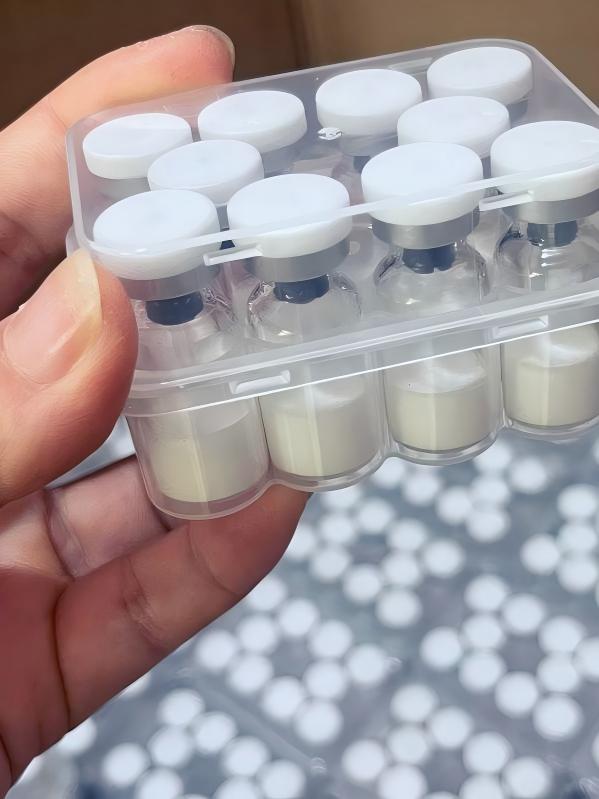
| Product appearance | Lyophilized powder, consistent color, correct labeling |
| Documentation accuracy | COA batch number matches vial batch number |
| HPLC verification (if tested independently) | Purity within ±2% of COA claim |
| LC-MS verification (if tested independently) | Mass matches theoretical within ±1 Da |
| Packaging condition | Intact, cold packs still cold, proper insulation |
| Shipping time | Within 10 business days |
| Communication during process | Responsive, helpful, accurate tracking information |
Verification Summary Checklist
Use this checklist to score potential suppliers:
| Verification Layer | Pass | Needs Review | Fail |
|---|---|---|---|
| Business license provided with manufacturing scope | ☐ | ☐ | ☐ |
| Equipment list with specific equipment details | ☐ | ☐ | ☐ |
| Facility photos or video tour provided | ☐ | ☐ | ☐ |
| Willing to arrange live video facility tour | ☐ | ☐ | ☐ |
| COAs are batch-specific with varying data | ☐ | ☐ | ☐ |
| HPLC chromatograms are complete and authentic | ☐ | ☐ | ☐ |
| LC-MS data confirms peptide identity | ☐ | ☐ | ☐ |
| Batch production records available | ☐ | ☐ | ☐ |
| Raw material traceability is documented | ☐ | ☐ | ☐ |
| Technical questions answered with substance | ☐ | ☐ | ☐ |
| Five-Question Test passed | ☐ | ☐ | ☐ |
| Trial order matches specifications | ☐ | ☐ | ☐ |
Scoring:
- 10–12 Pass: Reliable manufacturer, proceed with confidence
- 7–9 Pass: Probable manufacturer, address open items before full commitment
- 4–6 Borderline: Significant risk of being a trading company
- 0–3 Fail: High probability of trading company or unreliable supplier
RPL Peptide: Verification-Ready Manufacturer
RPL Peptide (Qingdao RPL Biotechnology Co., Ltd.) is prepared for full remote verification by international buyers.
Verification readiness:
- Business registration available upon request
- Equipment list with specific equipment details provided
- Facility photos and video tours available
- Batch-specific COAs with full HPLC and LC-MS data
- Batch production records with raw material lot traceability
- Technical team available for chemistry discussions
- Trial orders accepted at any quantity
For pricing and product information: Browse RPL Peptide’s product catalog →
For technical documentation: data.rplpeptides.com →
For manufacturing process details: lab.rplpeptides.com →
Related Resources
- Peptides from China: A Complete Buyer Guide →
- How to Choose a Peptide Supplier in China →
- China Peptide Manufacturer vs Peptide Supplier: Key Differences →
- Peptide Supplier Audit Checklist for International Buyers →
- Peptide Quality Control: HPLC, LC-MS, Purity Standards & COA Compliance →
- RPL Peptides Lab — Technical Documentation →
- RPL Peptides Data & Documentation Center →