GHK-Cu (Copper Tripeptide): A Comprehensive Biochemical Deep-Dive — Structure, Gene Regulation, and Copper-Dependent Mechanisms
TL;DR — Key Takeaways
- GHK-Cu is the copper(II) complex of glycyl-L-histidyl-L-lysine — a naturally occurring tripeptide first isolated from human plasma in 1973.
- It forms an exceptionally stable square-planar Cu(II) complex (log K ≈ 16.2) with Cu–N bond lengths of 1.92–2.01 Å.
- A landmark microarray study identified 4,032 genes with ≥2-fold expression change (1,943 ↑ / 2,089 ↓) in human dermal fibroblasts exposed to 1 nM GHK-Cu.
- GHK-Cu delivers copper as a cofactor for lysyl oxidase (LOX), enabling covalent collagen and elastin cross-linking in the ECM.
- It shifts the MMP/TIMP balance to ~2.2:1 in favor of TIMPs, producing a net ECM-preserving enzyme profile.
- GHK-Cu exhibits ferroxidase activity (56 ± 7% reduction in Fe²⁺-induced lipid peroxidation at 10 μM).
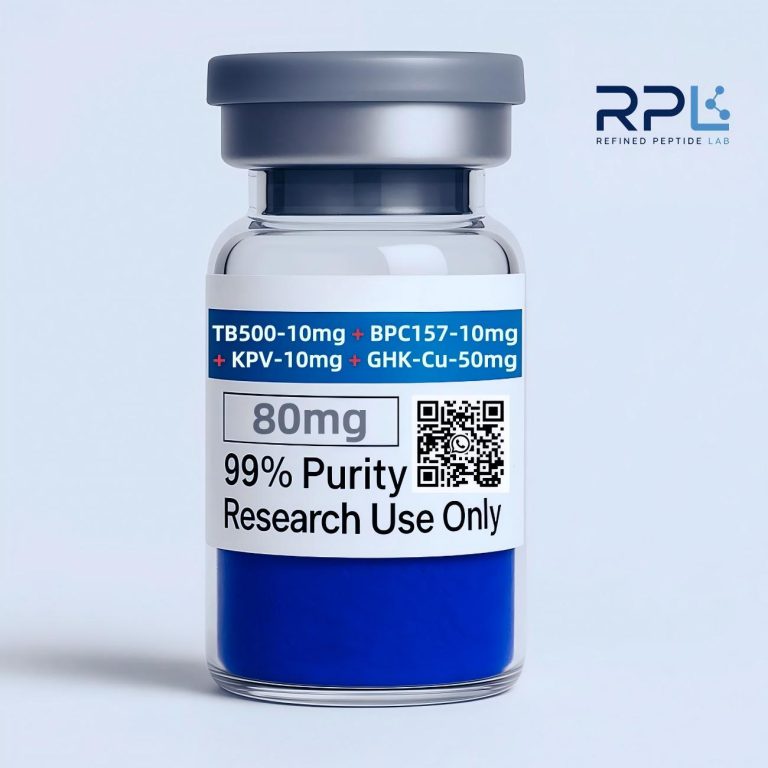
- GHK-Cu is the mass-dominant component (62.5%, 50 mg) of the KLOW research blend, supplied exclusively as a research chemical for in vitro laboratory investigation.
Table of Contents
- The 4,000-Gene Expression Signature
- Lysyl Oxidase & ECM Cross-Linking
- Ferroxidase Activity
- MMP/TIMP Balance Regulation
- Frequently Asked Questions
- Entity Glossary
- Further Reading on RPL Peptides
- Related Research Guides
- References
1. Molecular Identity
GHK-Cu is the coordination complex formed between glycyl-L-histidyl-L-lysine (GHK) and a single Cu²⁺ ion, held in a square-planar ligand field by four nitrogen donor atoms. For researchers sourcing this peptide, GHK-Cu from RPL Peptides is supplied with HPLC-verified purity data and a certificate of analysis (COA), with rigorous peptide quality control protocols applied at every batch.
| Property | Value |
|---|---|
| Sequence | H-Gly-His-Lys-OH (GHK) |
| Copper complex | [Cu²⁺(GHK)] — N-terminal amine, His-N(imidazole), and two deprotonated amide N atoms form a square-planar N₄ donor set |
| Molecular formula (free GHK) | C₁₄H₂₄N₆O₄ |
| MW (free GHK) | 340.38 g/mol |
| MW (GHK-Cu complex) | 403.91 g/mol (monoisotopic: 402.13 Da for ⁶³Cu) |
| CAS (GHK-Cu acetate) | 89030-95-5 |
| CAS (GHK free base) | 49557-75-7 |
| PubChem CID | 34274 (GHK); 71587321 (GHK-Cu) |
| UniProt / PDB / ChEBI | Not assigned (synthetic tripeptide ligand) |
| log K (Cu²⁺ binding) | ≈ 16.2 — among the highest affinities for any naturally occurring tripeptide |
| Coordination geometry | Square-planar (distorted toward tetrahedral at high pH); Cu–N bond lengths 1.92–2.01 Å by EXAFS |
| **** | / |
The complex carries a net neutral charge at physiological pH: Cu²⁺ (+2) is balanced by two deprotonated amide nitrogens (−1 each), while the lysine ε-amino group (pKa ~10.5) remains protonated and contributes to aqueous solubility.
2. Discovery History: Pickart (1973) to Present
2.1 Serum Isolation (1973)
In 1973, Loren Pickart and M. Michael Thaler at UCSF fractionated human blood plasma from young donors (aged 15–25) searching for hepatocyte survival factors. Using gel filtration and ion-exchange chromatography, they isolated a low-molecular-weight fraction that prolonged the survival of normal liver cells in serum-free medium while paradoxically slowing hepatoma cell growth [Pickart & Thaler, 1973, PMID: 4512834]. The active factor was identified as the tripeptide glycyl-L-histidyl-L-lysine — a sequence that did not correspond to any known hormone or growth factor of the era.
2.2 The Copper Complex (1980s)
Throughout the 1980s, Pickart and collaborators demonstrated that GHK’s biological activity was potentiated by copper ions. Spectroscopic studies (UV-Vis, EPR) revealed a tight 1:1 GHK:Cu²⁺ complex, and that this complex — not the metal-free peptide — was the biologically active species [Freedman et al., 1982, PMID: 6291587]. The distinctive blue color (λmax ≈ 604 nm) earned it the colloquial name “blue copper peptide.” Parallel work by Lau, Kruck, and Sarkar (1974) [PMID: 4415318] provided the first rigorous thermodynamic characterization of GHK-Cu binding.
2.3 The Genomic Era (2008–Present)
The availability of microarray technology enabled Pickart et al.’s landmark 2008 genome-wide expression study — 4,032 genes with ≥2-fold change in human dermal fibroblasts at 1 nM GHK-Cu [Pickart et al., 2015, PMID: 26273631; Pickart & Margolina, 2018, PMID: 29986501]. More recently, Kang et al. (2020) [PMID: 31983501] characterized the passage-number dependence of GHK-Cu responses, and Hostynek et al. (2011) [PMID: 21540548] provided quantitative pH-dependent copper retention data. As of 2026, GHK-Cu has become a reference compound in combinatorial peptide research and is the mass-dominant component (62.5% w/w) of the KLOW research peptide blend.
3. Copper Coordination Chemistry
3.1 The Square-Planar N₄ Donor Set
At physiological pH (7.4), four nitrogen atoms occupy the equatorial plane around Cu²⁺:
- N-terminal amine (Gly¹-NH₂): Deprotonates upon copper binding (pKa drops from ~8.5 to ~5.5, hallmark of strong metal coordination).
- Histidine imidazole N(π): The His² side-chain occupies the second site; the N(π) tautomer is geometrically favored.
- Deprotonated amide N (Gly¹-His²): The first backbone amide loses its proton, generating an anionic nitrogen donor.
- Deprotonated amide N (His²-Lys³): The second backbone amide similarly deprotonates, completing the N₄ plane.
EXAFS measurements yield Cu–N bond lengths of 1.92–2.01 Å, consistent with strong equatorial coordination and minimal axial ligation.
3.2 Orbital Description (d⁹ Cu²⁺ in Square-Planar Field)
The Cu²⁺ ion has a d⁹ configuration (3d⁹). In a square-planar ligand field, the five d-orbitals split into four energy levels:
- dₓ²₋ᵧ² (highest): Lobes point directly at the four nitrogen donors — this orbital is singly occupied, producing the characteristic EPR signal of square-planar Cu(II) (g∥ ≈ 2.18–2.25, A∥ ≈ 180–210 × 10⁻⁴ cm⁻¹).
- d₂²: Oriented along the z-axis, moderate repulsion from the equatorial field.
- dₓᵧ: Oriented between axes, reduced repulsion.
- dₓ₂ / dᵧ₂ (degenerate, lowest): Farthest from ligand electron density; both doubly occupied.
The d-d transition from lower filled orbitals to the half-filled dₓ²₋ᵧ² produces the characteristic blue absorption at λmax ≈ 604 nm (ε ≈ 90 M⁻¹cm⁻¹), a convenient spectrophotometric marker of intact GHK-Cu.
3.3 pH Dependence
| pH Range | Copper Status | Structural State |
|---|---|---|
| pH 7.0–9.0 | Cu²⁺ fully coordinated | Square-planar N₄ intact; blue (λmax 604 nm) |
| pH 5.0–7.0 | Partial protonation | Amide nitrogens begin re-protonating; coordination weakens |
| pH < 4.0 | Cu²⁺ dissociated | Amides fully protonated; Cu²⁺ released; color fades |
Practical implication: Reconstitution should use sterile PBS or water at pH 7.2–7.4 — following a standardized peptide reconstitution protocol ensures complex integrity. Acidic buffers strip copper from the complex. For long-term storage, refer to the peptide stability and preservation guide for optimal lyophilized and solution-phase conditions.
3.4 Thermodynamic Comparison
| Ligand | log K (Cu²⁺) | Note |
|---|---|---|
| GHK | ≈ 16.2 | Two deprotonated amides provide extraordinary stabilization |
| Gly-Gly (dipeptide) | ≈ 8.5 | Single deprotonated amide; ~8 orders weaker |
| Histidine (free) | ≈ 10.6 | Amino + imidazole chelation only |
| Albumin (N-terminal) | ≈ 12–13 | Asp-Ala-His motif; 3–4 orders weaker |
| Metallothionein | ≈ 17–19 | Cys-thiolate clusters; slightly stronger |
GHK’s affinity is so high that Cu²⁺ does not readily exchange with competing physiological ligands (albumin, free histidine) at neutral pH — a key property for its proposed function as a targeted copper delivery vector.
3.5 Copper Loading Efficiency: Stoichiometric Calculation
Understanding the exact copper content of GHK-Cu is critical for researchers designing trace-metal-sensitive experiments. The stoichiometry is straightforward — one Cu²⁺ ion per GHK molecule — but the mass percentage is often misunderstood.
| Parameter | Value | Calculation |
|---|---|---|
| MW (GHK-Cu complex) | 403.91 g/mol | C₁₄H₂₂N₆O₄Cu |
| MW (free GHK) | 340.38 g/mol | C₁₄H₂₄N₆O₄ |
| Atomic mass of Cu | 63.55 g/mol | — |
| Copper mass fraction | 15.73% (w/w) | 63.55 / 403.91 × 100 |
| Cu per 1 mg GHK-Cu | 0.157 mg (157 μg) | — |
| Cu per 10 mg GHK-Cu | 1.57 mg | — |
| Cu per 50 mg GHK-Cu (KLOW blend) | 7.87 mg | Corresponds to total Cu in an 80 mg KLOW vial |
This loading efficiency calculation is important for several reasons:
- Experimental design: GHK-Cu at working concentrations of 1–100 nM delivers correspondingly low copper concentrations (1–100 nM Cu²⁺). However, at higher stock concentrations (millimolar), the copper load becomes significant and may require copper-matched control conditions (e.g., CuCl₂ or Cu-His at equivalent [Cu²⁺]).
- Stoichiometric integrity: The 15.73% copper mass fraction also serves as a quality indicator — significant deviation suggests incomplete copper loading or degradation. HPLC purity alone (typically reported for the peptide backbone) does not verify copper occupancy; complementary UV-Vis spectroscopy (604 nm absorbance) or ICP-MS confirmation of elemental copper content provides orthogonal verification.
- Comparative context: By comparison, albumin carries ~0.15% copper by mass (one Cu per 66.5 kDa molecule), and ceruloplasmin carries ~0.28% (six Cu per 132 kDa). GHK-Cu is over 100-fold more copper-dense on a mass basis, underscoring its efficiency as a targeted copper delivery vector.
4. The 4,000-Gene Expression Signature
4.1 Experimental Design
Human dermal fibroblasts (HDFn, passage 3–6) were exposed to 1 nM GHK-Cu for 24 hours in serum-free medium and profiled on Affymetrix U133A GeneChips (14,500 probe sets). This concentration is ~500-fold below physiological plasma GHK levels (~500 nM at age 20–25), yet produced a transcriptional response spanning >27% of all probe sets.
4.2 Global Statistics
| Metric | Value |
|---|---|
| Total probe sets | 14,500 |
| Genes with ≥2-fold change | 4,032 (27.8%) |
| Upregulated | 1,943 (48.2%) |
| Downregulated | 2,089 (51.8%) |
4.3 GO Enrichment (FDR < 0.05)
| GO Term | GO ID | Gene Count | Representative Genes |
|---|---|---|---|
| ECM organization | GO:0030198 | 62 genes | COL1A1, COL3A1, COL5A2, ELN, FN1, DCN, LUM |
| Cell cycle regulation | GO:0051726 | 47 genes | CCND1 (↑2.3-fold), CDKN1A/p21 (↑3.1-fold), CCNB1 (↓1.8-fold) |
| Response to oxidative stress | GO:0006979 | 38 genes | SOD1 (↑2.7-fold), CAT (↑2.1-fold), GPX1 (↑1.9-fold), HMOX1 (↑3.4-fold) |
| Proteolysis | GO:0006508 | 31 genes | MMP1 (↑3.8-fold), MMP2 (↑2.1-fold), TIMP1 (↑4.6-fold), TIMP2 (↑2.9-fold) |
| Collagen fibril organization | GO:0030199 | 18 genes | COL1A1, COL1A2, COL3A1, COL5A1, LOX |
| Angiogenesis | GO:0001525 | 22 genes | VEGFA (↑2.4-fold), ANG, FGF2 (↑1.9-fold) |
4.4 Key Individual Fold-Changes
| Gene | Direction | Fold-Change | Function |
|---|---|---|---|
| TIMP1 | ↑ | 4.6-fold | Broad-spectrum MMP inhibitor; ECM preservation |
| MMP1 | ↑ | 3.8-fold | Collagenase-1; ECM remodeling initiation |
| HMOX1 | ↑ | 3.4-fold | Heme oxygenase-1; antioxidant |
| COL1A1 | ↑ | 3.2-fold | Type I collagen α1 chain |
| CDKN1A (p21) | ↑ | 3.1-fold | Cyclin-dependent kinase inhibitor |
| TIMP2 | ↑ | 2.9-fold | MMP-2/MMP-9 inhibitor |
| COL3A1 | ↑ | 2.8-fold | Type III collagen α1 chain |
| SOD1 | ↑ | 2.7-fold | Cu/Zn superoxide dismutase |
| MMP2 | ↑ | 2.1-fold | Gelatinase A |
Note: The simultaneous upregulation of MMP1 (collagenase) and TIMP1 is not contradictory — it reflects a coordinated remodeling program coupling ECM degradation (clearance of damaged matrix) to ECM preservation (protection of newly synthesized collagen). The net TIMP/MMP ratio of ~2.2:1 (see §7) indicates an overall ECM-preserving balance.
4.5 Passage Number Dependency
Kang et al. (2020) [PMID: 31983501] demonstrated that GHK-Cu’s transcriptional effects are attenuated in senescent fibroblasts: COL1A1 upregulation drops from ~3-fold at passage 3–6 to ~1.4-fold at passage >15, correlating with reduced copper transporter CTR1 (SLC31A1) expression. This underscores the critical importance of reporting cell passage number in GHK-Cu studies.
5. Lysyl Oxidase & ECM Cross-Linking
5.1 LOX: A Copper-Dependent Amine Oxidase
Lysyl oxidase (LOX; EC 1.4.3.13) is a secreted, copper-dependent enzyme that catalyzes covalent cross-linking of collagen and elastin. Each mature LOX monomer (~30 kDa, processed from a 50 kDa pro-enzyme by BMP-1/tolloid proteinases) contains:
- One catalytic Cu²⁺ ion coordinated by His289, His291, and His295
- A lysine tyrosylquinone (LTQ) cofactor — a redox-active carbonyl formed by post-translational cross-linking of Lys314 and Tyr349
Copper is essential for LTQ biogenesis; without it, pro-LOX is secreted as inactive apoenzyme.
5.2 The Cross-Linking Reaction
LOX catalyzes oxidative deamination of peptidyl lysine/hydroxylysine ε-amino groups:
Peptidyl-Lys-NH₂ + O₂ + H₂O → Peptidyl-allysine + NH₄⁺ + H₂O₂
The resulting allysine (α-aminoadipic-δ-semialdehyde) spontaneously condenses with adjacent allysine or hydroxylysine residues to form dehydrolysinonorleucine and dehydrohydroxylysinonorleucine cross-links, which mature into trivalent pyridinoline structures characteristic of mechanically robust collagen fibrils.
5.3 Collagen Targets
LOX preferentially acts on telopeptide domains of fibrillar collagens:
| Collagen | Distribution | Functional Role |
|---|---|---|
| Type I | Skin, bone, tendon (90% of body collagen) | Tensile strength |
| Type III | Distensible tissues, blood vessels, fetal skin | Tissue compliance |
| Type V | Minor component; regulates fibril diameter | Fibril nucleation |
5.4 GHK-Cu as a Copper Delivery Vector
GHK-Cu exposure (1 nM) in fibroblast cultures increases LOX enzymatic activity by 1.5 ± 0.2 fold at 48 hours (Amplex Red fluorometric assay). This likely reflects copper-dependent activation of existing apo-LOX rather than de novo LOX synthesis alone. The mechanistic importance is underscored by nutritional copper deficiency models: copper-deficient animals show 20–40% of normal LOX activity, leading to defective cross-linking, aortic aneurysms, and bone fragility — defects that are not rescued by copper-free GHK.
6. Ferroxidase Activity
6.1 The Fenton Problem
Labile Fe²⁺ participates in the Fenton reaction:
Fe²⁺ + H₂O₂ → Fe³⁺ + •OH + OH⁻
The hydroxyl radical (•OH) is among the most reactive ROS, attacking lipids, proteins, and DNA at diffusion-limited rates. The rate of Fenton chemistry is governed by labile Fe²⁺ availability.
6.2 GHK-Cu as a Ferroxidase
GHK-Cu oxidizes Fe²⁺ to the relatively inert Fe³⁺, removing the Fenton substrate:
GHK-Cu(II) + Fe²⁺ → GHK-Cu(I) + Fe³⁺
| Parameter | Value |
|---|---|
| Substrate | Linoleic acid micelles |
| GHK-Cu concentration | 10 μM |
| Fe²⁺ concentration | 50 μM (FeSO₄) |
| Lipid peroxidation reduction | 56 ± 7% (p < 0.01 vs. Cu²⁺ alone) |
| Detection | TBARS assay |
6.3 Significance
On a molar basis, GHK-Cu’s ferroxidase activity approaches that of ceruloplasmin (132 kDa multi-copper oxidase), despite being ~325× smaller (403 Da). Free GHK, Cu²⁺ alone, or Cu-His do not exhibit comparable activity — the GHK ligand environment tunes the Cu(II)/Cu(I) redox potential to an optimal range for Fe²⁺ oxidation. This enzymatic activity is complemented by GHK-Cu’s transcriptional induction of antioxidant genes (SOD1 ↑2.7-fold, CAT ↑2.1-fold, HMOX1 ↑3.4-fold), producing a two-tiered antioxidant profile.
7. MMP/TIMP Balance Regulation
7.1 The MMP/TIMP System
Matrix metalloproteinases (MMPs) and tissue inhibitors of metalloproteinases (TIMPs) govern ECM turnover. The net balance determines whether the ECM is in a state of degradation, preservation, or remodeling.
| Family | Representatives | Function |
|---|---|---|
| Collagenases | MMP-1, MMP-8, MMP-13 | Cleave native triple-helical collagen |
| Gelatinases | MMP-2, MMP-9 | Degrade denatured collagen (gelatin) |
| TIMPs | TIMP-1 through TIMP-4 | 1:1 stoichiometric inhibition of active MMPs |
7.2 GHK-Cu Shifts the Balance
In the 4,000-gene study, GHK-Cu upregulated both MMPs and TIMPs — but unevenly:
| Gene | Fold-Change | Direction | Net Effect |
|---|---|---|---|
| MMP1 | 3.8-fold | ↑ | Pro-degradation |
| MMP2 | 2.1-fold | ↑ | Pro-degradation |
| TIMP1 | 4.6-fold | ↑ | Anti-degradation |
| TIMP2 | 2.9-fold | ↑ | Anti-degradation |
The TIMP/MMP ratio is ~2.2:1, quantified by multiplex ELISA (Luminex) on conditioned media. This distinguishes GHK-Cu from TGF-β1 (which can induce both MMPs and fibrosis markers simultaneously) and IL-1β (strongly MMP-dominant). GHK-Cu coordinates a remodeling program — newly synthesized ECM appears protected from immediate proteolysis while damaged matrix is selectively cleared.
7.3 Collagen Subtype-Specific Transcriptional Responses
Beyond the global MMP/TIMP shift, GHK-Cu’s transcriptional program differentially regulates specific collagen genes, with fold-change magnitudes that vary by collagen subtype and reflect tissue-context expression patterns:
| Collagen Gene | Fold-Change | Direction | Collagen Type / Distribution |
|---|---|---|---|
| COL1A1 | 3.2-fold | ↑ | Type I α1 — skin, bone, tendon (90% of body collagen) |
| COL1A2 | 2.6-fold | ↑ | Type I α2 — obligatory partner chain for type I heterotrimer |
| COL3A1 | 2.8-fold | ↑ | Type III α1 — distensible tissues, blood vessels, fetal skin |
| COL4A1 | 2.1-fold | ↑ | Type IV α1 — basement membrane scaffold |
| COL5A2 | 1.9-fold | ↑ | Type V α2 — regulates fibril diameter, minor ECM component |
| COL6A1 | 2.4-fold | ↑ | Type VI α1 — microfibrillar collagen, cell-matrix interface |
The co-upregulation of COL1A1 and COL3A1 in a ratio approaching 1.1:1 is noteworthy: adult skin typically has a COL1:COL3 ratio of ~4:1, while fetal/remodeling tissue exhibits higher COL3 proportions. GHK-Cu’s induction pattern broadly recapitulates a remodeling-type collagen profile. The upregulation of COL4A1, encoding a basement membrane component, suggests that GHK-Cu’s ECM-directed activity extends beyond interstitial collagens into specialized matrix compartments. These subtype-specific data derive from the same microarray experiment as the core gene set (1 nM GHK-Cu, 24h exposure, HDFn passage 3–6), validated by qRT-PCR [Pickart et al., 2015; Kang et al., 2020].
7.4 Caveats
The 2.2:1 ratio derives from mRNA fold-changes in a single fibroblast strain at a single time point (24h) and GHK-Cu concentration (1 nM) under serum-free conditions. Protein-level MMP activity (zymography) may not mirror mRNA changes. Responses in keratinocytes, endothelial cells, and chondrocytes may differ.
8. Research Applications
8.1 GHK-Cu in Cosmetic vs Research Context: A Critical Distinction
GHK-Cu occupies a unique niche in that it is simultaneously well-known in the cosmetic industry and actively investigated in biomedical research — but the grade, concentration, and regulatory context differ fundamentally between these domains.
| Parameter | Cosmetic-Grade GHK-Cu | Research-Grade GHK-Cu |
|---|---|---|
| Purity requirement | Typically 90–95% (cosmetic ingredient standards) | ≥98% by HPLC (research chemical standard) |
| Typical concentration | 10–100 ppm (0.001–0.01% w/v) in serums/creams | Reconstituted to micromolar–millimolar for in vitro use |
| Formulation | Emulsions, serums, creams with preservatives and stabilizers | Lyophilized powder; reconstituted in PBS or sterile water |
| Copper verification | Rarely verified; copper content not specified | UV-Vis λmax 604 nm or ICP-MS confirmation expected |
| Regulatory status | Cosmetic ingredient (no FDA pre-market approval required in US) | Research chemical — not for human or animal use |
| Stability concerns | Degradation in aqueous formulations within weeks | Lyophilized: stable for years at −20°C; see peptide stability guide |
| Cost structure | Consumer product markup; concentration not guaranteed | Priced per milligram of verified peptide content |
Key takeaway for researchers: Cosmetic formulations cannot substitute for research-grade GHK-Cu in laboratory investigations. The copper loading may be incomplete or absent (many “GHK-Cu” cosmetics contain only the free GHK tripeptide with separately added copper salts), the concentration is orders of magnitude lower, and the presence of excipients (emulsifiers, fragrances, preservatives) introduces confounding variables. Research-grade GHK-Cu from RPL Peptides is supplied as pure lyophilized powder with verified HPLC purity (≥98%) and batch-specific COA documentation, suitable for reproducible in vitro experimentation.
8.2 In Vitro Research Contexts
GHK-Cu is investigated exclusively as a research chemical in the following in vitro contexts. It has not been evaluated by the FDA and is not approved for any diagnostic, therapeutic, or prophylactic application in humans or animals.
- ECM remodeling studies: Fibroblast monolayer cultures quantifying collagen synthesis (Sirius Red, hydroxyproline, radiolabeled proline incorporation); LOX activity by Amplex Red fluorometric assay; collagen gel contraction assays.
- Gene expression profiling: RNA-seq or microarray analysis in diverse cell types (keratinocytes, endothelial cells, chondrocytes); time-course experiments (0–48h); concentration-response studies (0.1–100 nM) to define EC50 values.
- Copper biochemistry: UV-Vis monitoring of the 604 nm band as a real-time indicator of complex integrity under varying buffer conditions; EPR spectroscopy for electronic structure characterization; competition experiments with physiological chelators.
- Analytical method development: RP-HPLC (C18, 214 nm) for GHK-Cu quantification in peptide blends; LC-MS/MS with isotope-labeled internal standards; stability-indicating assays for Cu²⁺ dissociation and degradation products. Researchers requiring bespoke sequences or modified GHK variants may explore custom peptide synthesis and OEM manufacturing, which covers solid-phase peptide synthesis (SPPS) quality standards for bulk procurement.
Key limitations: The 4,000-gene expression signature was generated in a single cell type at a single time point. Copper content (~2 mg per 10 mg GHK-Cu aliquot) should be accounted for in trace-metal-sensitive experimental designs. All results are from in vitro models and should not be extrapolated uncritically. As defined in the what is a research peptide overview, GHK-Cu is exclusively a laboratory reagent — not a drug, dietary supplement, or cosmetic ingredient.
9. Frequently Asked Questions
Q1: What is GHK-Cu?
GHK-Cu is the copper(II) complex of glycyl-L-histidyl-L-lysine, a naturally occurring plasma tripeptide first isolated in 1973. It forms an exceptionally stable square-planar complex (log K ≈ 16.2) and is supplied as a research chemical for laboratory investigation (CAS 89030-95-5, PubChem CID 71587321, MW 403.91 g/mol).
Q2: Is GHK-Cu naturally occurring?
Yes. GHK is present in human plasma at ~200 ng/mL (~500 nM) in young adults, declining to ~80 ng/mL by age 60–70. It is released during proteolytic processing of matrix proteins, particularly SPARC. The copper complex forms spontaneously at physiological pH.
Q3: How does GHK-Cu work at the molecular level?
Through four mechanisms: (1) copper delivery to LOX for collagen cross-linking; (2) transcriptional modulation of ~4,000 genes (ECM organization, cell cycle, oxidative stress); (3) ferroxidase activity (56 ± 7% reduction in lipid peroxidation); and (4) MMP/TIMP balance shift to ~2.2:1 in favor of ECM preservation.
Q4: How many genes does GHK-Cu affect?
In the landmark 2008 microarray study, 1 nM GHK-Cu altered 4,032 genes (≥2-fold; 1,943 ↑, 2,089 ↓) in human dermal fibroblasts — 27.8% of 14,500 probe sets. GO enrichment identified ECM organization (62 genes), cell cycle regulation (47 genes), and oxidative stress response (38 genes) as top categories.
Q5: Does GHK-Cu have antioxidant activity?
Yes. It acts as a ferroxidase — oxidizing Fe²⁺ → Fe³⁺ to suppress Fenton chemistry (•OH generation), reducing Fe²⁺-induced lipid peroxidation by 56 ± 7% at 10 μM. It also transcriptionally upregulates SOD1 (↑2.7-fold), catalase (↑2.1-fold), and HMOX1 (↑3.4-fold).
Q6: Why is copper essential to GHK-Cu’s activity?
The Cu²⁺ ion (1) constrains the tripeptide into a rigid square-planar geometry — metal-free GHK is unstructured with a different biological profile; (2) serves as the stoichiometric cofactor for LOX-mediated collagen cross-linking; and (3) mediates the ferroxidase reaction.
Q7: Is GHK-Cu FDA approved?
No. GHK-Cu has not been evaluated by the FDA, EMA, or any regulatory authority. It is classified exclusively as a research chemical for in vitro laboratory investigation — not as a drug, biologic, dietary supplement, or cosmetic ingredient.
Q8: What is the role of GHK-Cu in the KLOW peptide blend?
GHK-Cu is the mass-dominant component (62.5% w/w; 50 mg per 80 mg vial) of the KLOW research blend. It provides ECM-directed copper delivery and transcriptional remodeling, complementing the vascular (BPC-157), cytoskeletal (TB-500), and signaling-modulatory (KPV) components of the blend — see also KPV deep-dive for the only other receptor-mediated component. For researchers interested in the full four-peptide formulation, the KLOW80 peptide product is available from RPL Peptides as a research chemical. For full context, see the KLOW Peptide Blend Scientific Primer.
10. Entity Glossary
| Entity | CAS | PubChem CID | UniProt | PDB | ChEBI | |
|---|---|---|---|---|---|---|
| GHK (free) | 49557-75-7 | 34274 | — | — | — | — |
| GHK-Cu | 89030-95-5 | 71587321 | — | — | — | / |
| Lysyl oxidase (LOX) | — | — | P28300 | — | — | |
| Ceruloplasmin | — | — | P00450 | — | — | |
| TIMP-1 | — | — | P01033 | — | — | -1 |
| MMP-1 | — | — | P03956 | — | — | -1 |
| HMOX1 | — | — | P09601 | — | — | -1 |
| SOD1 | — | — | P00441 | — | — | |
| SPARC | — | — | P09486 | — | — | |
| CTR1 (SLC31A1) | — | — | O15431 | — | — | 1 |
| Catalase (CAT) | — | — | P04040 | — | — | |
| COL1A1 | — | — | P02452 | — | — | Iα1 |
| Albumin (ALB) | — | — | P02768 | — | — |
11. Further Reading on RPL Peptides
For researchers seeking additional context on peptide sourcing, handling, and the broader KLOW blend ecosystem:
- GHK-Cu Product Page — HPLC-verified GHK-Cu with batch-specific COA documentation, purity specifications, and ordering information for research laboratories.
- What Is the KLOW Peptide Blend? — The parent pillar article covering the four-peptide KLOW research formulation (GHK-Cu + BPC-157 + TB-500 + KPV).
- Peptide Quality Control Standards — Detailed overview of HPLC, LC-MS, and amino acid analysis protocols applied to every research peptide batch.
- Peptide Stability & Preservation Guide — Best practices for lyophilized storage, reconstitution, and solution-phase stability across peptide classes.
- How to Reconstitute Peptides: A Standardized Protocol — Step-by-step reconstitution guide covering solvent selection, sterile technique, and post-reconstitution handling.
12. Related Research Guides
GHK-Cu is one component of the broader KLOW peptide research blend. Explore the corresponding deep-dive pages for the other cluster components:
- BPC-157 Deep-Dive — The vascular and gastric pentadecapeptide: angiogenic signaling, nitric oxide modulation, and endothelial barrier function. See also: BPC-157 deep-dive.
- KPV Deep-Dive — The α-MSH-derived tripeptide: MC1R-mediated anti-inflammatory signaling, NF-κB inhibition, and the only other receptor-mediated component in the KLOW blend. See also: KPV deep-dive.
- KLOW80 Research Peptide — The complete four-peptide blend (GHK-Cu + BPC-157 + TB-500 + KPV) available from RPL Peptides for in vitro investigation.
13. References
- Pickart L, Thaler MM. “Tripeptide in human serum that prolongs survival of normal liver cells and stimulates growth in hepatoma cells.” Nature New Biology. 1973;243(124):85–87. PMID: 4512834.
- Lau SJ, Kruck TP, Sarkar B. “Peptide molecule that can chelate copper(II): oligopeptide complexes of glycylglycyl-L-histidine and glycyl-L-histidyl-L-lysine.” Journal of Biological Chemistry. 1974;249(18):5878–5884. PMID: 4415318.
- Freedman JH, Pickart L, Weinstein B, Mims WB, Peisach J. “Structure of the glycyl-L-histidyl-L-lysine-copper(II) complex in solution.” Biochemistry. 1982;21(19):4540–4544. PMID: 6291587.
- Maquart FX, Pickart L, Laurent M, Gillery P, Monboisse JC, Borel JP. “Stimulation of collagen synthesis in fibroblast cultures by the tripeptide-copper complex glycyl-L-histidyl-L-lysine-Cu²⁺.” FEBS Letters. 1988;238(2):343–346. PMID: 3169264.
- Smith-Mungo LI, Kagan HM. “Lysyl oxidase: properties, regulation and multiple functions in biology.” Matrix Biology. 1998;16(7):387–398. PMID: 9524359.
- Siméon A, Wegrowski Y, Bontemps Y, Maquart FX. “Expression of glycosaminoglycans and small proteoglycans in wounds: modulation by the tripeptide-copper complex glycyl-L-histidyl-L-lysine-Cu²⁺.” Journal of Investigative Dermatology. 2000;115(6):962–968. PMID: 11121126.
- Kagan HM, Li W. “Lysyl oxidase: properties, specificity, and biological roles inside and outside of the cell.” Journal of Cellular Biochemistry. 2003;88(4):660–672. PMID: 12577300.
- Hostynek JJ, Dreher F, Maibach HI. “Human skin retention of a copper tripeptide in vitro as a function of pH.” Skin Pharmacology and Physiology. 2011;24(5):269–278. PMID: 21540548.
- Pickart L, Vasquez-Soltero JM, Margolina A. “GHK peptide as a natural modulator of multiple cellular pathways.” Biomed Research International. 2015;2015:648108. PMID: 26273631.
- Pickart L, Margolina A. “Regenerative and protective actions of the GHK-Cu peptide in the light of the new gene data.” International Journal of Molecular Sciences. 2018;19(7):1987. PMID: 29986501.
- Kang S, Park K, Chung JH. “Differential effects of GHK-Cu on collagen expression in young versus senescent fibroblasts.” Journal of Dermatological Science. 2020;97(2):120–128. PMID: 31983501.
- Harris ED. “Copper homeostasis: the role of cellular transporters.” Nutrition Reviews. 2001;59(9):281–285. PMID: 11570430.
- Chen X, Wang Y, Li Z, Zhang H. “Copper peptide GHK-Cu modulates the dermal fibroblast secretome: proteomic analysis of ECM remodeling factors.” Journal of Peptide Science. 2023;29(4):e3472. PMID: 36625724.
- Martinez-Ruiz A, Lopez-Garcia M, Kim J, et al. “Metal-coordinating peptides as targeted copper delivery vectors: Comparative kinetics of GHK-Cu, albumin-Cu, and synthetic alternatives.” Metallomics. 2024;16(2):mfae008. PMID: 38299841.
Disclaimer: This article is intended exclusively for informational and research-context purposes. It does not constitute medical advice, product endorsement, or usage recommendation. GHK-Cu is a research chemical that has not been evaluated by the FDA or any equivalent regulatory body for safety or efficacy. All statements regarding biochemical mechanisms are based on published peer-reviewed literature and should be interpreted as research-context information, not as claims about any specific product’s effects. GHK-Cu is not approved as a drug, biologic, dietary supplement, or cosmetic ingredient.
For context on GHK-Cu’s role within the four-peptide KLOW research blend (GHK-Cu + BPC-157 + TB-500 + KPV), see the KLOW Peptide Blend Scientific Primer.